How Many Australian Businesses Use AI? (2026 Figures)
ABS reported 12% AI use in 2024–25; the National AI Centre reported 44% SME adoption in February 2026. How their surveys differ and which industries lead.
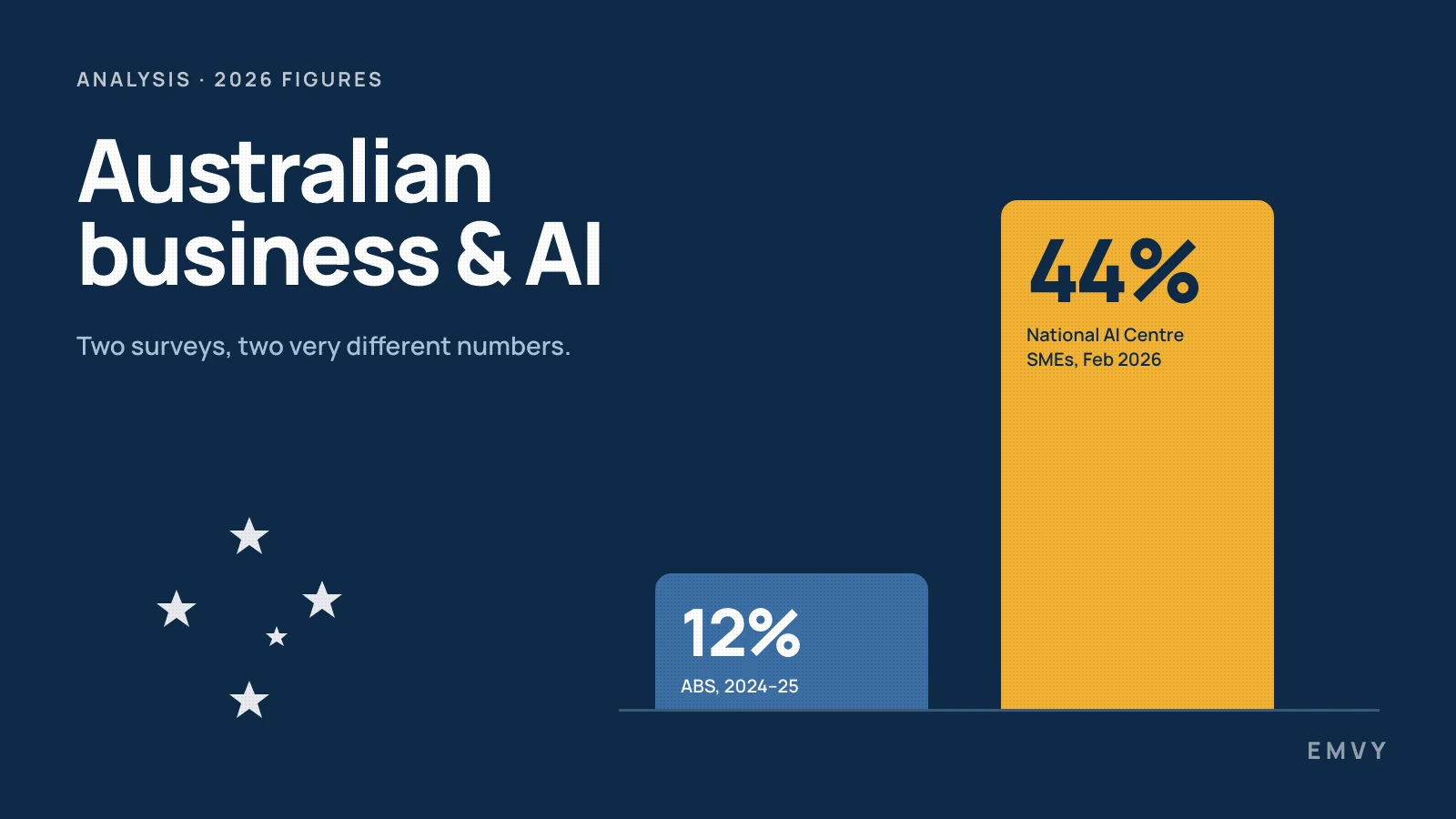
The ABS estimated that 12% of employing businesses in its survey scope used AI in 2024–25. Separately, the National AI Centre reported 44% AI adoption among Australian small and medium enterprises in February 2026.
These are separate survey findings. They are not a numerical range for AI adoption. They cover different populations and periods, and ask different questions.
Why the two numbers are so far apart
In the ABS survey, businesses ticked which technologies they used, and AI was one option on that list. By the ABS's own description, the question isn't designed to measure how much a business uses it. Its methodology covers employing businesses, with exclusions including education and training and public administration. It is not a count of every Australian business or every sole trader.
The National AI Centre's monthly tracker surveys SME owners and decision-makers, with 400 completed surveys each month. Responses are weighted to reflect industry and location as well as employee numbers. It asks businesses whether they use AI broadly or within a limited part of the business, or are implementing it.
The ABS reference year ended on 30 June 2025; its release was published on 25 June 2026. The National AI Centre's December 2025 to February 2026 overview reports 43% adoption across that quarter and 44% for February alone. The gap between the two surveys does not tell us how much adoption grew.
Which industries use AI the most?
Selected industries from the 2024–25 ABS figures look like this (ABS):
| Industry | Businesses using AI |
|---|---|
| Information, media and telecommunications | 38% |
| Professional, scientific and technical services | 24% |
| Financial and insurance services | 24% |
| Mining | 18% |
| Health care and social assistance | 17% |
| Retail trade | 9% |
| Construction | 6% |
| Accommodation and food services | 5% |
| Agriculture, forestry and fishing | 3% |
| Transport, postal and warehousing | 1% |
Construction sits at 6%, but it isn't the lowest: accommodation and food services recorded 5%, agriculture, forestry and fishing 3%, and transport, postal and warehousing 1% (ABS). That's the gap I see most in Perth. Tradies and builders have repeated paperwork, like quotes, job notes and invoices, and low AI use.
Innovation-active small businesses were also far more likely to use AI: 19% compared with 4% for those not innovating (ABS).
What that looks like on the ground
In the owner conversations I have in Perth, the February 2026 finding matches what I hear. Most businesses have someone using ChatGPT or Copilot for the odd email.
Far fewer have AI built into a job that repeats every week, with their own price lists and templates and someone checking the output. That's where the time actually comes back. A blank chat now and then saves a few minutes. A quote job loaded with your price list saves time every week.
How to move from occasional use to a proper setup
- Pick one job that repeats every week.
- Give the AI your own documents for that job, like a price list or past examples.
- Save the instructions so anyone on the team gets the same result.
- Have a person check the output before it goes out.
- Time the job before and after.
I go through which job to pick in six jobs a small business can hand to AI first.
Questions owners ask
Is my business behind? If someone in the business uses ChatGPT now and then, you're in the same place as most of your neighbours. You pull ahead when one weekly job runs on it.
Will these numbers change? Yes. Keep the reference period beside each number. The National AI Centre tracker provides ongoing SME data, while the ABS methodology describes a biennial survey. The figures above refer to the named periods, not a live count of businesses using AI today.
If you want to work out which weekly job to start with, book 30 minutes.
Jake