
Google Maps and AI Search: A Guide for Perth Businesses
Understand Google Maps ranking, Google AI eligibility and ChatGPT search access, with practical checks for a Perth business profile and website.
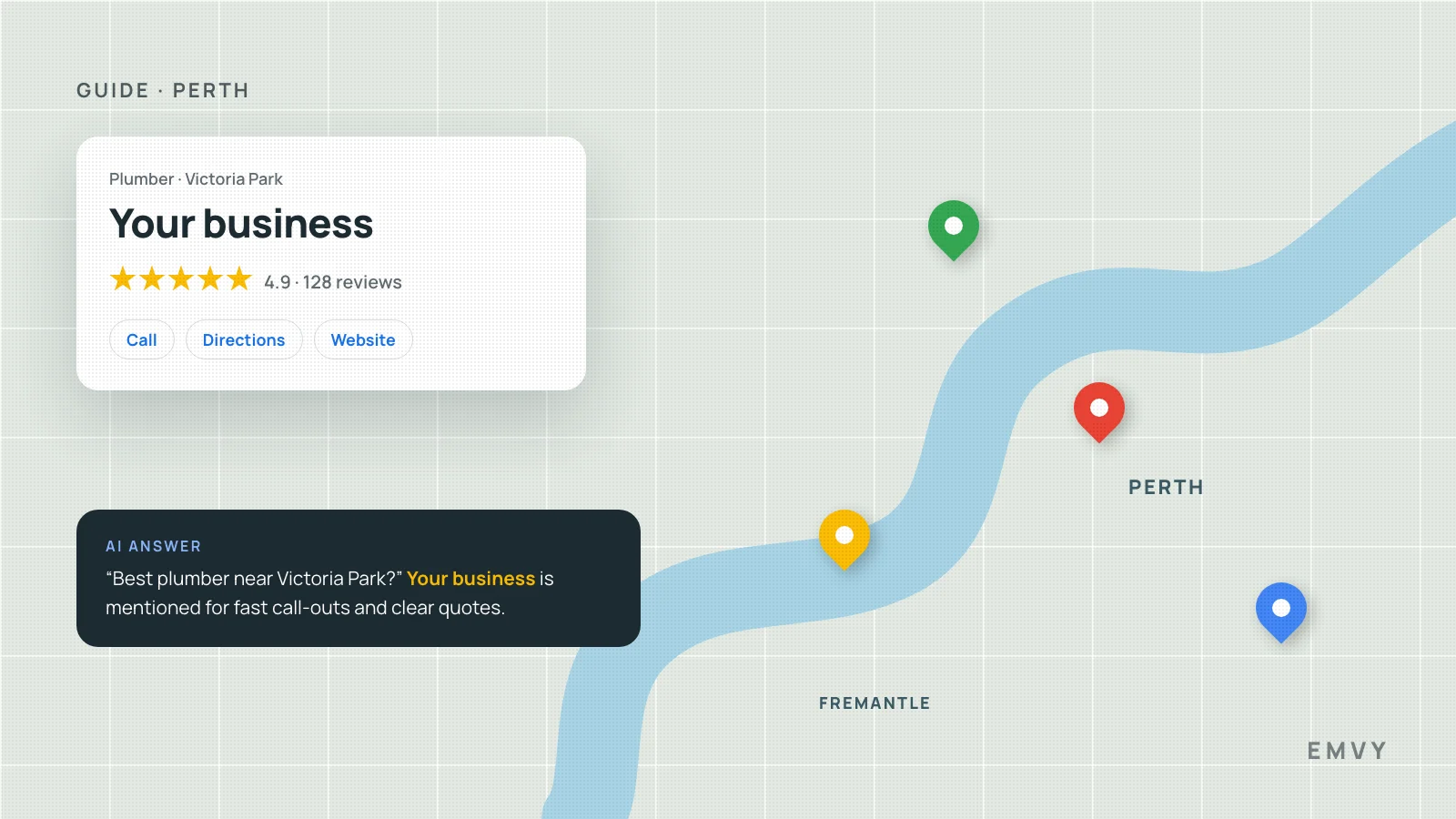
To improve local discovery, keep your Google Business Profile accurate and make your website explain what you do and where you work. For Google AI answers and ChatGPT search, check website access and the relevant search controls separately: a complete profile or a collection of positive reviews does not guarantee inclusion.
These are connected discovery channels, but they aren't the same ranking system. A Perth owner should know which one needs attention before paying for an “AI search” fix.
How Google decides which local businesses to show
Google's local-ranking guidance describes three main factors: relevance, distance and prominence.
Relevance is how closely the profile matches the search. Give Google a specific business category, accurate services and useful details about what customers can expect. A person searching for an emergency plumber needs to know whether emergency work is actually offered.
Distance concerns how far the business is from the searcher. Adding suburb names to a website doesn't move the business closer to every customer. Describe the areas you serve rather than treating a long location list as a ranking shortcut.
Prominence is how well-known the business is. Google says this includes information such as websites linking to the business and customer reviews. It does not publish a formula that turns a chosen number of photos or reviews into a particular position.
Complete information helps Google understand the business and helps customers evaluate it. That is a reason to maintain the profile, not a promise of a top position.
What to fix on your Business Profile
Start with the details that could mislead or stop a customer:
- Verify the profile and use an appropriate primary category.
- Check contact details and current hours, including exceptions.
- Describe services accurately and add relevant genuine photos.
- Ask for genuine customer reviews and respond helpfully.
- Check that important details agree with your website and other business listings.
For a business that visits customers rather than receiving them at its address, use Google's service-area business guidance. It explains when to remove the address from the public profile and how to describe the area served.
Treat photos as evidence of the business and its work, not a quota. There isn't a verified minimum in the local-ranking source that makes an AI system recommend you.
Google AI answers need a website check too
Google's current generative AI search guidance says its AI features use the Search index and core ranking systems. Pages must be indexed and eligible to appear with a snippet, and the site must be included through the Search generative AI setting in Search Console.
That makes the website a separate part of the job. Check that the page opens publicly, contains its important information as readable text and has useful links from elsewhere on the site. In Search Console, check whether the specific URL is indexed and which canonical Google selected.
An accessible page with correct metadata can still be unindexed or not selected for a particular answer. Google explicitly says eligibility doesn't guarantee that it will crawl, index or show the content.
The content should also be worth selecting. Explain a real service question thoroughly, provide suitable evidence and make any current claims traceable. Rewriting the same generic advice for every Perth suburb adds pages without necessarily adding useful information.
ChatGPT search has different crawler controls
OpenAI's crawler documentation identifies OAI-SearchBot as its search crawler. A website owner should check that robots.txt permits it and that the hosting or firewall isn't blocking its published crawler addresses.
GPTBot is a separate control for training-related crawling. ChatGPT-User handles certain user-initiated visits; a successful visit by that agent isn't proof that the site is included in ChatGPT search.
Ask whoever manages your website to check those distinctions. Do not assume that opening the page yourself, or allowing one AI user agent, proves that every search crawler can fetch it.
This is an access check. OpenAI does not provide a formula in that documentation saying a particular number of reviews or business listings guarantees a recommendation.
Do you need special AI files or schema?
Google's guidance says no special AI schema or llms.txt file is required for its generative search features. Ordinary SEO and useful, original content remain relevant.
Accurate Article and business information can help describe a page or organisation. Structured data should match what people can actually read. It does not replace a useful explanation, correct indexing or clear author identity.
Don't buy a package just because it promises an “AI-ready” file. Ask which verified access or content problem it fixes, and how the result will be checked. Our AI consultant buying guide gives more questions to ask before commissioning work.
A practical check for a Perth service business
Consider a fictional electrician covering Scarborough and nearby suburbs. The website has an emergency-service page, but the opening hours are old and the contact link is broken.
Fixing those details helps a real customer immediately. Next, check that the Business Profile describes the actual service area. Then inspect the website page's index status and crawler access, rather than adding more suburb pages before understanding whether the existing one can be found.
Keep a small record of each layer:
| Layer | What to verify |
|---|---|
| Business Profile | Current details and the services offered |
| Website | Working page, readable useful content and contact route |
| Google indexing | URL status and selected canonical in Search Console |
| Google AI eligibility | Snippet eligibility and the current site inclusion setting |
| ChatGPT search access | OAI-SearchBot rules and hosting access |
| Actual visibility | Dated searches, cited URLs and available performance reports |
| Business response | Attributable visits and completed enquiries |
A citation isn't a website visit, and a visit isn't a booking. Keep those outcomes separate when deciding whether a change helped. Google's current guidance points to a Generative AI performance report; check what is available for your property rather than assuming it is already connected.
Where to start
Fix inaccurate business information and broken customer paths first. Then check indexing and search access before diagnosing why an AI answer didn't mention you. Improve the page's evidence and usefulness instead of chasing a guaranteed-inclusion trick.
If the wider question is how to put AI to work inside the business, start with our practical Australian business guide. That is a different job from getting the website found.
Book a conversation if you want help separating a website-access problem from a content or business-profile problem.
Jake