Microsoft names Hermes Agent in its MAI Code 2 rollout
Microsoft plans to bring MAI Code 2 models to Hermes. Here's what changes, which business builds could benefit and what the announcement doesn't include.
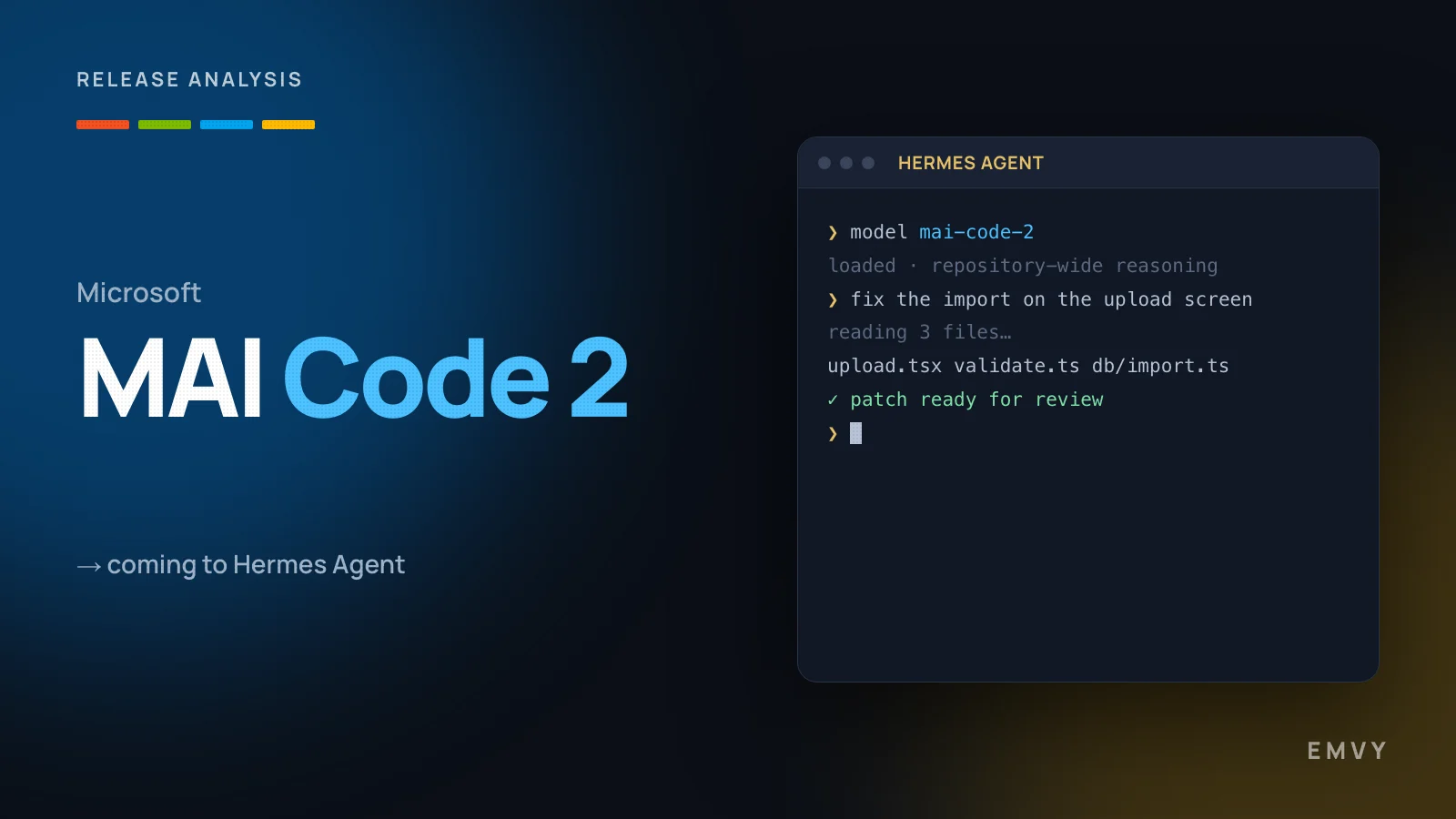
Microsoft has named Hermes Agent as a planned destination for MAI Code 2 and MAI Code 2 Flash, its new coding models. The opportunity for a business is another model option for building and maintaining useful tools inside an existing agent environment, rather than starting again with a different system.
That could matter for the little jobs that keep piling up: a broken import, an awkward report or a form that almost does what the business needs. Microsoft is explicitly targeting everyday coding work with these models.
The interesting part is the combination. A model helps reason through the change; Hermes supplies the tools and working context needed to carry it out. Whether that combination is worth adopting depends on what it can finish for you.
What Microsoft actually announced
In its 17 November 2026 announcement, Microsoft introduced two models with different intended jobs:
| Model | Microsoft's stated focus | A business task worth evaluating |
|---|---|---|
| MAI Code 2 | Multi-file implementation, deeper debugging, repository-wide reasoning and interface work | Repair an import feature that touches the upload screen, validation and database handling |
| MAI Code 2 Flash | Code explanations, targeted edits, routine fixes and rapid iteration | Explain an unfamiliar script, then make one bounded change and run its checks |
The announcement lists both in GitHub Copilot and Code 2 Flash in a limited-access Microsoft Foundry preview. It names Hermes among the platforms planned to receive the models next.
That is the announcement's availability statement, not a confirmation that either model is selectable in your Hermes account today. The rollout needs to be checked against the actual provider and account before a setup guide can give reliable instructions.
Why a different model inside Hermes matters
A model and an agent environment do different jobs.
The model interprets a request and chooses its next step. Hermes can give it tools, relevant files and reusable instructions, with memory and scheduled work where configured. The official Hermes documentation describes those capabilities separately from its model-provider setup.
Think of a coding job as a workbench. The model is one part of that workbench. The project files and the tests are other parts, and the permissions decide what can be changed.
If a new model becomes available through a supported route, the interesting comparison is whether it does a particular job better within that environment. You don't have to assume that changing the model means rebuilding every instruction and connection. You do have to check that the new model can use the tools and follow the requirements reliably.
For an owner, this changes the buying question from “which AI has the most impressive demo?” to “which setup can maintain the tool we actually use?”
Four business builds where this could be useful
These are proposed uses of the documented coding capabilities, not jobs we have run with the MAI models.
Fix the spreadsheet import that wastes someone's morning
A business receives a stock export every week. The column names change slightly, a duplicate appears and the import needs cleaning up by hand.
The coding assignment could be to improve the existing importer: accept the approved column variations, identify duplicate records and explain what was rejected. The useful output is changed code with sample files that demonstrate the behaviour.
Code 2's multi-file focus makes it a candidate for a change spanning the upload interface and the data-handling code. Flash is a candidate for a smaller, well-defined repair. Neither should invent a rule for merging records; the business must supply that decision.
Improve a dashboard around the way the team works
A dashboard can look polished and still omit the one filter staff need every day.
A bounded assignment might add a date filter to the existing view and preserve how its totals are calculated. The test is whether the selected dates produce the expected result, including an empty period. Microsoft specifically highlights interface and visualisation work for Code 2.
That makes dashboard work a reasonable evaluation subject. It doesn't establish that a new chart is accurate or that a better-looking page will improve the business. Check the figures against a known source.
Repair a booking form without rebuilding the app
Perhaps a service business has a form that accepts an enquiry but loses the preferred appointment date.
The useful coding job is to trace that field from the form into the stored record, fix the missing connection and test it. A focused repair is easier to inspect than a request to “rebuild our whole booking system”.
It also gives the person reviewing the work a clear finish line: submit the sample enquiry and confirm that the same date appears in the correct record.
Understand and maintain a small internal script
A team may depend on a short script whose original author is no longer around. Before changing it, someone needs to know which files it reads and what happens when information is missing.
A model designed for explanations and targeted edits could help produce that map, then make a small supported change. The maintainer should run it on copied sample inputs and inspect the files it produces.
This is where another capable routine-work model could be useful: making smaller maintenance jobs worth evaluating, rather than reserving AI coding for a dramatic new application build.
What does this mean for Microsoft 365 connections?
The verified news is Microsoft's plan to distribute coding models through Hermes Agent, not a new connection to every Microsoft business application.
The announcement also describes MAI Work Flash serving Microsoft products. That is separate from the planned coding-model distribution. Seeing Excel and Teams in the same announcement doesn't mean Hermes has gained access to your documents or accounts. Those connections and their permissions still need to be established for the actual job.
Does Microsoft's lower-cost claim mean cheaper business systems?
Microsoft positions the models around coding performance relative to cost. Its announcement publishes benchmark comparisons and explains the evaluation conditions, including the use of promotional pricing in some comparisons.
That is evidence about Microsoft's reported evaluations. It is not an estimate of what your business will save.
A model that costs less per unit of usage can still cost more to operate if it needs repeated attempts or more human correction. The relevant calculation includes the whole job: running it, reviewing the result and maintaining what was built.
For a small change, compare the total effort required to get an acceptable result. Don't compare only the first response or the model's advertised rate.
Where the models may not be the right fit
Microsoft says the models are not yet tuned for harder problems such as fundamental scientific research and very long-horizon agent work. That matters if the intended use is an agent handling a broad, open-ended assignment over many steps.
An agent fixing a specific validation bug is a different proposition from an agent independently operating an entire company function. The announcement supports evaluating everyday coding jobs, not treating every task in Hermes as covered by a new general-purpose guarantee.
You also need a reason to write code at all. If an existing app already has the required setting, use it. If a fixed transfer solves the problem, a new custom application may add maintenance without adding value.
The broader agent-selection guide explains where coding agents, general work agents and workflow builders fit.
How to evaluate the combination if your account has access
Start by checking the actual model catalogue and access route. Hermes supports several providers, but support for a provider is not proof that every model it offers is available to every account. Use the current Hermes provider documentation and verify the model shown for your account.
Then choose one existing coding job with a known requirement. Here is an example evaluation brief:
The sample stock importer currently creates a second record when the same file is uploaded twice. Find the cause and propose a fix that preserves the existing stock quantities. Add a test for the repeated upload and another for missing item identifiers. Work on the sample project only and show the resulting code changes and test output.
Compare candidate models with the same starting code and allowed tools. Keep the acceptance checks fixed. Record what passed, how many corrections were needed and the time the reviewer spent checking it.
Inspect the application behaviour as well as the tests. A passing test can be too narrow if the new code breaks another path that was never checked. For a form or dashboard, open the changed page and exercise the relevant interaction.
Use Hermes' documented security controls to choose appropriate permissions and isolation. Do the first evaluation away from live customer records. Those controls organise access; they don't decide whether a business rule is correct.
What I'd take from this announcement
The useful possibility is making everyday software maintenance easier to justify. More options for routine coding could help businesses improve the tools they already have, rather than accepting each awkward step as permanent.
Hermes being named in Microsoft's rollout makes that a relevant development for people building with agents. The work now is to verify availability and the access route for your account, then compare a real task, without pretending a launch announcement has already delivered the result.
For an owner, bring the annoying specific job. “This import duplicates records” is a much better starting point than “we need AI everywhere”.
The AI provider guide covers the separate choice of provider and business workspace.
Book a conversation if you have an existing tool that nearly does the job and want to work out whether a small AI-assisted build is worth testing.
Jake